Membrane Cleaners & CIP Chemicals
Restore lost flow and salt rejection with our Industrial RO Membrane Cleaners. Formulated for Clean-In-Place (CIP) cycles, our chemicals target calcium scale, iron deposits, and organic bio-fouling to extend the life of your expensive membranes.
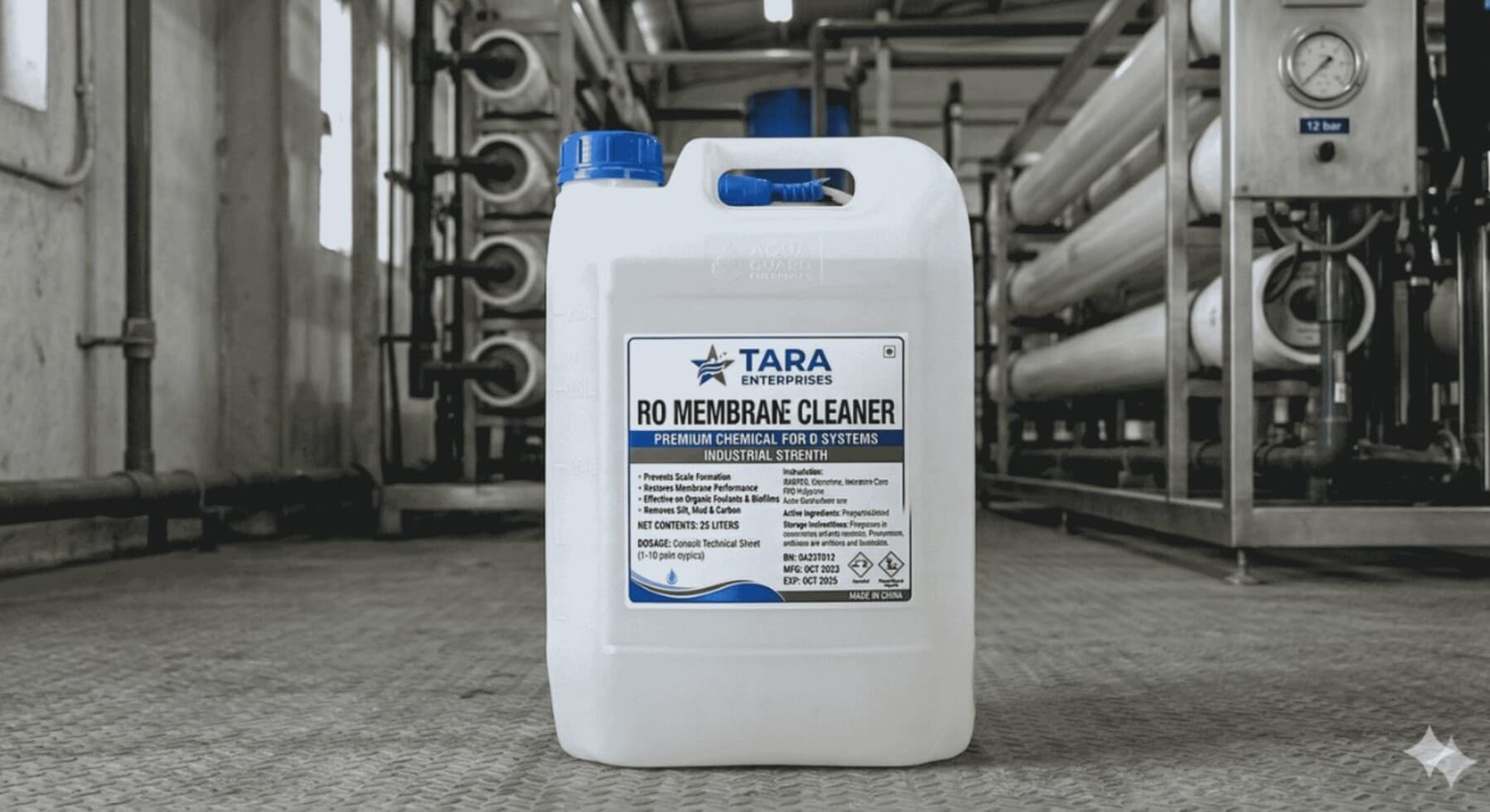
Advanced Decarbonizing & De-greasing
Regular cleaning prevents permanent fouling. We offer Dual-Action CIP Kits: Alkaline cleaners to break down organic slime and oils, and Acidic cleaners to dissolve hard mineral scaling and iron oxides. Our formulas are buffered to protect thin-film composite (TFC) membranes while delivering aggressive cleaning.
- Highly Effective Against Calcium & Magnesium Scale
- Disrupts Bio-film and Organic Fouling Layers
- Removes Iron and Metal Oxide Deposits
- Concentrated Liquid for Easy Dilution
- Safe for Filmtec, Hydranautics, and Toray Membranes
- Buffered pH to Maintain Membrane Integrity
CIP Chemical Range
- ✔ Alkaline Cleaner (pH 11.5 - 12.5)
- ✔ Acidic Cleaner (pH 2.0 - 3.0)
- ✔ Silica Specific Descalers
- ✔ Iron & Manganese Removers
- ✔ Non-Oxidizing Biocides (Sanitizers)
- ✔ Membrane Preservation Chemicals
Technical Specifications
| Formulation Type | Liquid Concentrate |
| Operating Temp Range | Max 35°C - 45°C during CIP |
| Recirculation Time | 1 - 2 Hours (Depending on fouling) |
| Target Contaminants | Organics, Colloids, Hardness, Metals |
| Packaging | 5L, 20L, and 50L HDPE Carboys |
Selection Guide
| Cleaning Grade | Primary Target | Key Output |
|---|---|---|
| Alkaline (Low pH) | Silica & Mineral Scale | Restore Differential Pressure |
| Alkaline (High pH) | Bio-foulants & Organics | Restore Permeate Flow |
| Acidic Descaler | Iron & Carbonate Scale | Improved Water Purity |
| Biocide Flush | Bacteria & Algae | Stable Biological Control |
Superior Membrane Restoration for RO Recovery
Don't replace your membranes prematurely. Our specialized CIP cleaners remove deep-seated fouling to bring your plant back to design specifications.
Tara Enterprises provides specialized RO Membrane Cleaning Chemicals in Baddi, catering to the pharma and bottling plants where high permeate flow is critical. If your plant has seen a 10-15% drop in flow or a rise in differential pressure, our CIP chemicals are the first line of defense.
For industries in Northern India dealing with high iron and mineral content, our Acidic CIP Formulations safely dissolve carbonate and metal oxide scales, preventing the permanent 'baking' of minerals onto the membrane surface.
Deep Penetration
Formulated with surfactants to penetrate and lift stubborn bio-slime layers.
Scale Chelation
Actively chelates mineral salts to hold them in solution during the wash.
Enzyme Action
Alkaline variants specifically designed to break down long-chain organic polymers.
Restoration Focus
Can recover membranes deemed 'fouled beyond use' with proper CIP soak cycles.
Whether you are performing a Routine Maintenance Clean or an Emergency CIP due to pre-treatment failure, we provide the technical guidance on temperature, soak times, and pH monitoring to ensure a safe and successful cleaning cycle.
Chemical & CIP Spares
Fouling Analysis
Not sure if your membranes need acid or alkali wash? We offer autopsy and fouling analysis to determine the right chemical for your CIP.
Speak to ExpertFrequently Asked Questions
When should I clean my RO membranes?
You should initiate a CIP when the permeate flow drops by 10%, the salt passage increases by 10%, or the differential pressure across the vessel increases by 15% from baseline values.
Should I clean with Acid or Alkali first?
For most organic or bio-fouled systems, start with Alkaline (High pH). For mineral scale or iron fouling, Acidic (Low pH) is used. Often, a dual-stage clean is required for total restoration.
How long should I circulate the chemical?
A typical CIP takes 1 to 2 hours of circulation followed by a 30-60 minute soak. For heavily fouled membranes, multiple soak and flush cycles may be necessary.
Can I use standard detergent for cleaning?
No. Standard detergents can cause irreversible damage to the thin-film composite (TFC) layer. Only use specialized, buffered membrane cleaners designed for reverse osmosis.